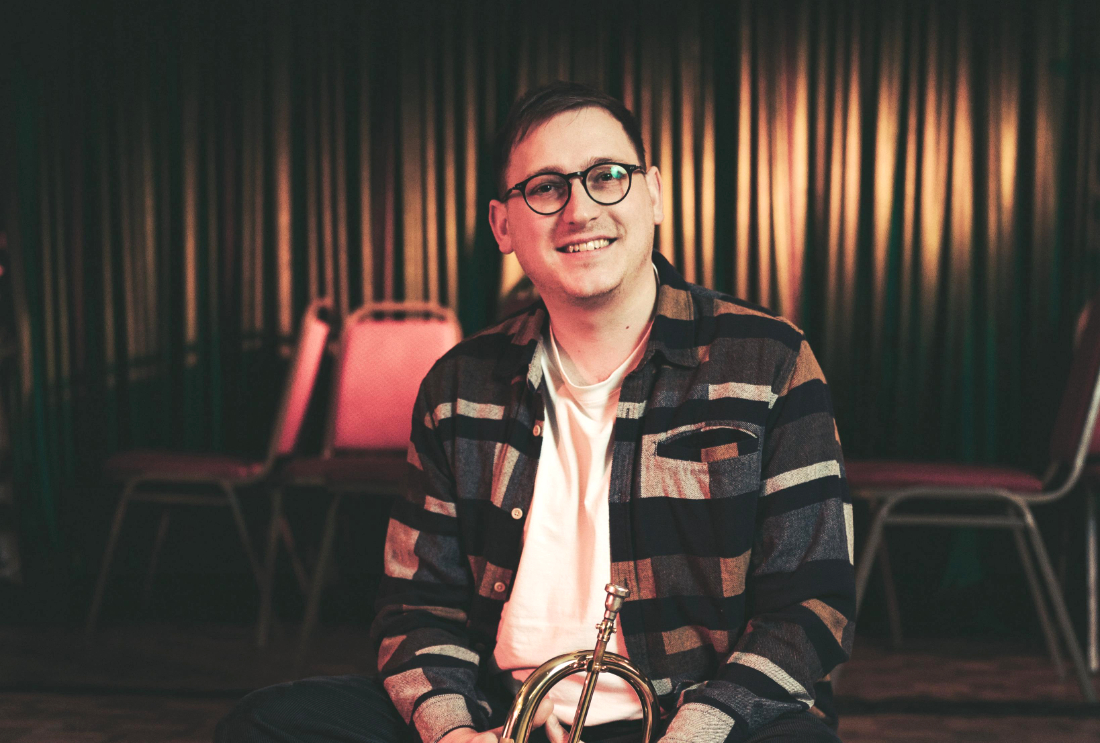
James Davison
01/04/26 13:11 Filed in:
InterviewsJames Davison, one of our newest members, lets loose on how he started as a jazz musician…
1. What got you into playing trumpet —and why jazz specifically?
I started playing the trumpet when I was 8 mainly because my Dad played the Trombone (and still does) and I remember going to see him play in various different jazz bands and big bands when I was little. I always thought the trumpets looked like they were having loads of fun stood up at the back of the big band playing really loud and high!
2. Do you remember when you first felt like, “yeah, I’m really a jazz player now”?
I guess when I had finished my post grad on the jazz course at the academy and started doing some gigs with older musicians - then people started calling me a “Jazzer”.
3. Were you mostly self-taught, or did you have teachers guiding you along the way?
I had some fantastic teachers all the way through, as well as my parents who are both musical, so definitely not “self-taught” as such. I think I worked out a few tunes on my own when I first got hold of a school cornet though. I seem to remember working out Somewhere Over the Rainbow on my own in my bedroom…
4. Who were you listening to a lot when you were learning?
I listened to loads of big band music growing up - Count Basie, Terry Gibbs, Bob Florence, Harry James, Buddy Rich, (I remember watching video tapes of both the Harry James big band and Buddy Rich on repeat at home with my Dad when I was a kid. Before DVDs came along…) and actually lots of Phillip Jones, German Brass, Canadian Brass and London Brass! Then just before I went to music college Mnozil Brass came along and I got pretty obsessed with them.
🎶 Advice for beginners
1. What’s one thing you wish you knew when you were just starting out?
That’s it’s not a race and there’s no shortcut. It just takes time, practise and patience. In the words of Clark Terry, “Keep on keepin’ on”.
2. What should someone focus on first—technique, theory, or just playing?
I personally think just playing. Working out the instrument for yourself a bit and not getting too bogged down with having to read music every time you play.
Playing by ear can be so much fun and learning to read music is hard at the start so not always having to read the music to be able to enjoy playing your instrument can be a really helpful thing for keeping beginners interested and engaged.
3. How important is improvisation early on, and how should beginners approach it?
I think it’s a great idea to encourage beginners to improvise. It can be really fun but also it can help players be more confident later on and less scared of the idea of playing without the sheet music in front of them. I was lucky to have got that kind of teaching from my Dad - he would play a bar or 2 of a melody and then I would play it back to him by ear. Basin Street Blues works really well for this! When you learn a tune in this way, when it then comes to improvising around the melody you already have the melody in your head as a reference and you’re not glued to the sheet music. That then allows room for creativity and other melodies to pop in to your head and then out of the instrument!
5. If someone wants to get good at jazz, what habits really make a difference?
Listening to lots of jazz! Transcribing solos really helps build language AND transcribing doesn’t always have to be writing a solo down. You can transcribe in your head over time by listening to something over and over again. I do this without even realising and without setting out to do so, sometimes over weeks, months or even years. Eventually some of it sticks and stays in my head. Once that’s happened and I can sing the phrase, or whistle it, it usually means I can play it. I’ve found that I’ve developed a lot of my jazz language this way.
A basic understanding of harmony is, of course, incredibly helpful as well, but listening and imitating are in my opinion the best ways to get good at playing any style of music.